Iwaejin
TL;DR · 'Iwaejin' (이왜진) is a Korean internet abbreviation that compresses the question 'igeoga wae jinjja-im?' — 'how is this real?' — into three syllables. It is used as an instinctive re…
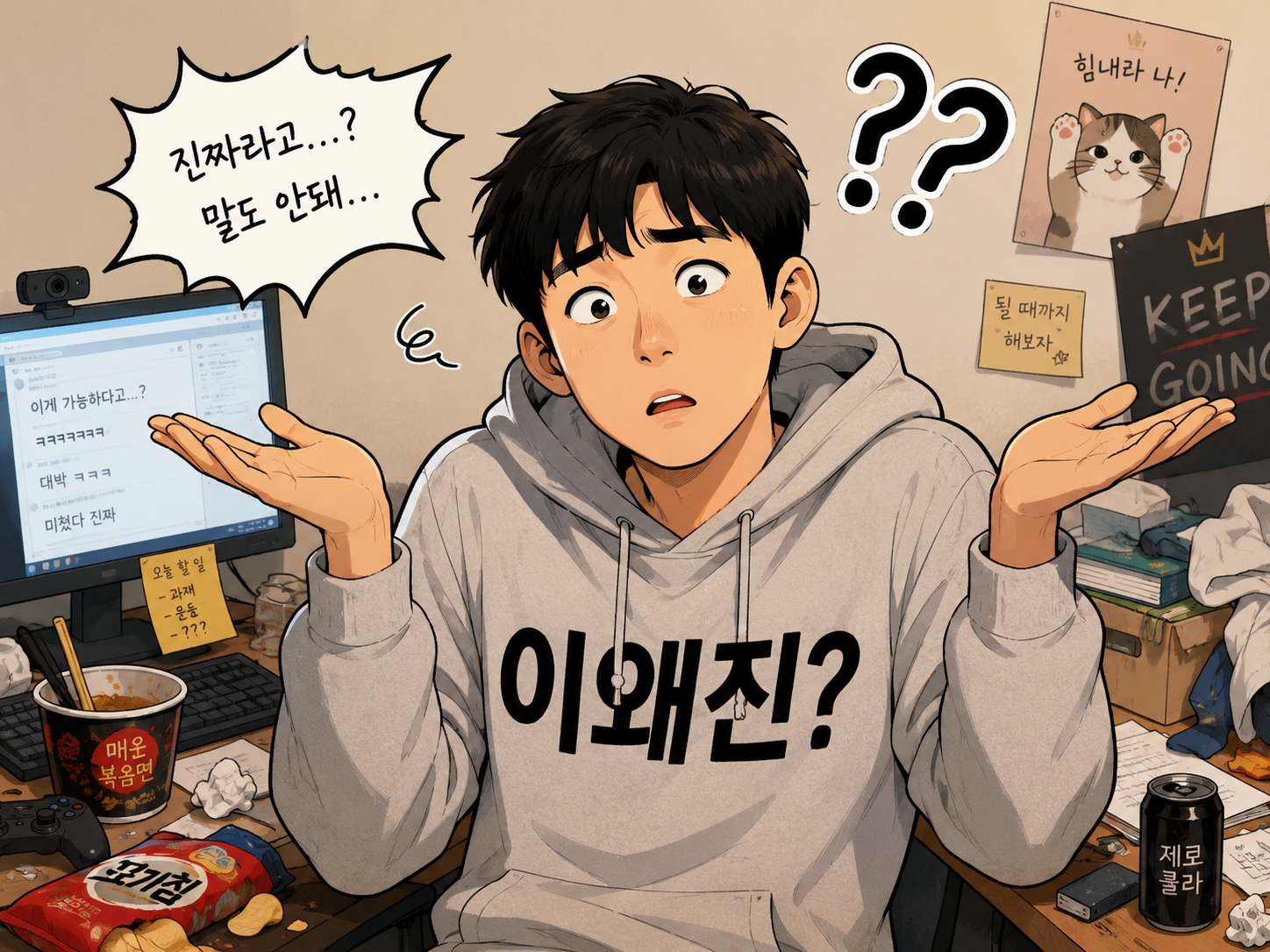
'Iwaejin' (이왜진) is a Korean internet abbreviation that compresses the question 'igeoga wae jinjja-im?' — 'how is this real?' — into three syllables. It is used as an instinctive reaction to a piece of information, image, or post that looks completely fake or wildly out of bounds yet turns out to be genuine. The short form bundles three reactions — 'really?', 'no way,' and 'I can't believe it' — into a single beat, and its compact form has made it one of the most common reaction phrases across Korean internet spaces, including X (formerly Twitter), Instagram comment threads, and DC Inside boards.
The lineage of 'iwaejin' goes back to the mid-2010s usage of 'silhwa-nya' (is this for real?), which became widespread on Korean community sites such as the Daum Pot movie and drama chat rooms, where users repeatedly questioned whether posts and chat snippets were genuine. AfreecaTV broadcaster and YouTuber Bogyeom popularized the phrase by sprinkling it through his content, and it eventually crossed over into mainstream television via 'My Little Television' and a Gag Concert sketch named 'Is This Real?' After that wave peaked, around 2019 to 2020 the slightly tighter and more rhythmic phrasing 'how is this real?' settled in on DC Inside and similar boards, and its three-syllable head-letter form 'iwaejin' was established as the standard reaction phrase across the Korean internet during the early 2020s.
Applications are simple yet broad. Common patterns include posts on X that screenshot an absurd headline with only 'iwaejin' as the caption, Instagram stories that share an unrealistic-looking photo and tack on 'iwaejinㅋㅋㅋ' (laughter), and community board comments that respond to bizarre stories with 'iwaejin;;' (a sweat-mark emoticon). It fits when someone's looks, talent, wealth, background, or relationships seem implausibly extreme; when an absurd accident or news item surfaces; or when a game produces an outcome of laughably low probability. Variants such as the emphasized 'iwaejin?', the laughing 'iwaejinㅋ', and the elongated 'i-i-iga waee jinjja?' are circulating naturally alongside the base form.
Linguistically, 'iwaejin' is an initial-syllable acronym that slices a sentence into three head letters and re-glues them, placing it in the same lineage as 'aljaltakkkkalsen' (figure it out and do it well), 'gapbunssa' (the mood suddenly cooled), and 'jonmattaeng' (extremely tasty). The functional difference is that most syllable-cut neologisms carry an evaluation or instruction, whereas 'iwaejin' carries an immediate emotional reaction in interrogative form. The arc from 'silhwa-nya' to 'iwaejin' is often cited as a clean example of how Korean internet speech keeps compressing while preserving the same 'unbelievable' feeling. English equivalents like 'no way,' 'is this real?', and 'how is this real?' exist, but the combination of question form and acronym is a feature distinctive to Korean coined words.
'Iwaejin' has been treated as more than a passing slang term and is widely seen as having entered everyday Korean conversation. It now turns up in casual KakaoTalk chats among friends, idle workplace banter, and quick jokes during class, and it is also used repeatedly in advertising copy and variety-show subtitles. By the mid-2020s, observers describe it as effectively part of Korean internet vocabulary rather than a one-season fad, and end-of-year slang roundups continue to include it. Its short, intuitive form lets it carry doubt and surprise at the same time, which is why 'iwaejin' is recorded as a representative case of how Korean internet speech has grown shorter and simpler while quietly widening its emotional range.