X를 눌러 Joy를 표하십시오
TL;DR · OriginThe source is Call of Duty: Advanced Warfare, a first-person shooter released in 2014. Shortly after the prologue's Seoul mission, protagonist Mitchell attends the funeral of…
Origin
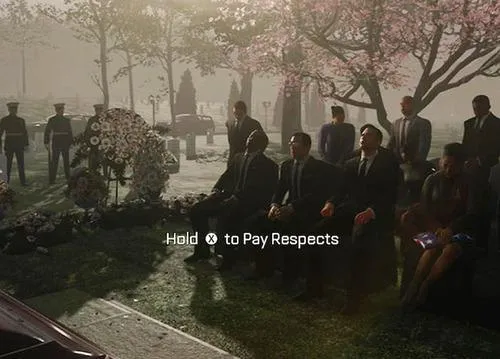
The source is Call of Duty: Advanced Warfare, a first-person shooter released in 2014. Shortly after the prologue's Seoul mission, protagonist Mitchell attends the funeral of his fallen comrade Will, and an on-screen prompt appears: "Hold ⓧ to Pay Respects." Mitchell is medically discharged following this scene.
The problem was where the prompt sat. The game reduced its heaviest moment — mourning a comrade's death — to a single button press (a quick-time event). Having the system instruct the player to perform an emotion struck players as tonally wrong. The scene and its path to meme status are documented on Namuwiki.
Spread
The decisive push came from American talk show host Conan O'Brien. Playing the game on his gaming segment, he hit the funeral prompt and openly mocked the design with a look of disbelief. As that clip circulated, "Press X to pay respects" moved beyond gaming circles into general internet usage.
Korea added a layer of wordplay. In the Korean translation, 조의 (jo-ui, "condolences") sounds close to 조이 (Jo-i), the Korean name of the League of Legends champion Zoe. So "Press X to pay 조의" was twisted into "Press X to pay Joy," which is why the Korean title of the meme is this pun rather than a straight translation. Korean circulation can be seen on theqoo and FMKorea.
Usage
It is used when something has ended or failed, to offer perfunctory, tongue-in-cheek condolences rather than genuine mourning. The point is performing sympathy, not feeling it.
- When someone's plan or project falls through
- Reacting to a service shutting down, a business closing, or a team disbanding
- Mock-consoling a friend over a trivial failure
People either post a screenshot of the original prompt UI or simply quote the line as text.
The line commonly expands into a fill-in-the-blank template — "Press X to pay ___" — with the blank swapped for whatever fits the situation. Because it began as a jab at a clumsy quick-time event, it is also invoked as a benchmark whenever another game handles emotional expression awkwardly.
The meme is frequently cited as a case where a game's failed piece of direction became the thing that publicized it most widely.