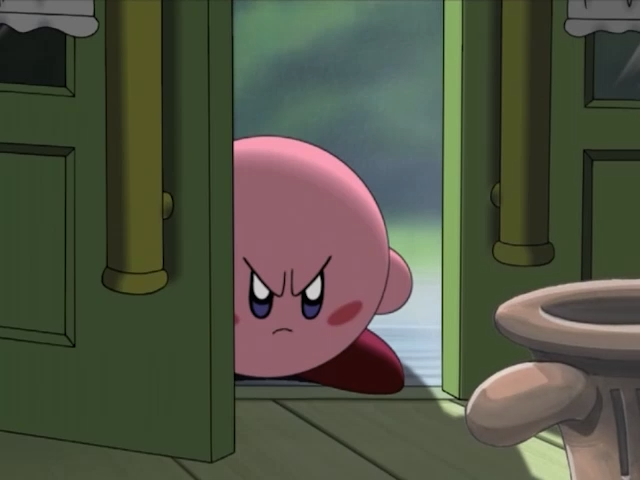
Angry Kirby
TL;DR · Origin"Angry Kirby" refers to the practice of altering Kirby's facial expression on Western box art for Nintendo's Kirby games. It isn't an officially named anything — the name stu…
Origin
"Angry Kirby" refers to the practice of altering Kirby's facial expression on Western box art for Nintendo's Kirby games. It isn't an officially named anything — the name stuck as fans lined up Japanese and North American covers side by side.
The earliest documented case is Kirby & the Amazing Mirror, released for Game Boy Advance on October 18th, 2004. Same game, but where the Japanese cover shows Kirby smiling as usual, the North American one gives him sharply angled brows and a hardened expression. It was not a one-off: Kirby: Nightmare in Dream Land (2002), Kirby Air Ride (2003), Kirby: Squeak Squad (2006) and Kirby Super Star Ultra (2008) all carry noticeably tougher faces on Western art.
Why They Did It
On this point there is testimony from the people involved. Leslie Swan, former localization director at Nintendo of America, explained in a Polygon interview published January 16th, 2025 that the fiercer look was meant to convey determination rather than anger: cute, sweet characters are popular with all ages in Japan, but in the U.S. tween and teen boys tend to be drawn to tougher characters.
Krysta Yang, a former Nintendo of America public relations manager, put it more bluntly in the same coverage: being labeled "kiddie" was effectively a curse for the company at the time, so it deliberately emphasized combat. The development side saw it similarly. Shinya Kumazaki, director of Kirby: Triple Deluxe, told GameSpot in 2014 that cute Kirby performs best in Japan while a strong Kirby who is really battling hard appeals more in the U.S. — while adding that gameplay is what ultimately matters.
Spread and Present Status
The joke lives entirely in the incongruity of a pink puffball scowling. Fans built side-by-side comparison images, and some drew parody covers applying the "angry Kirby treatment" to characters from entirely different properties.
The phenomenon itself is fading into the past tense, though. Nintendo has stopped pushing to make Kirby look cool, and recent titles largely keep his original smile across regional releases.
How It's Used
- As the standard example when discussing Japanese-versus-Western localization differences
- To depict a gentle character suddenly turning serious
- To criticize marketing that overrides a work's original tone
- To mock attempts to force a "tough" presentation onto something cute
Sources
- Game8, "'Angry Kirby' Explained by Former Nintendo Employees" — the January 16th, 2025 Polygon interviews with Leslie Swan and Krysta Yang, Shinya Kumazaki's 2014 GameSpot remarks, and the list of affected games
- Know Your Meme, "USA Covers' Kirby / Angry Kirby" — Amazing Mirror (October 18th, 2004) as the earliest case, plus comparison images and parodies
- TV Tropes, "American Kirby Is Hardcore" — the same phenomenon, with parallel cases from other series