Two Buttons
TL;DR · Origin"Two Buttons," also known as "Daily Struggle," began with a comic that animator Jake Clark posted to his Tumblr on October 25, 2014 (Know Your Meme entry). It shows a visibly…
Origin
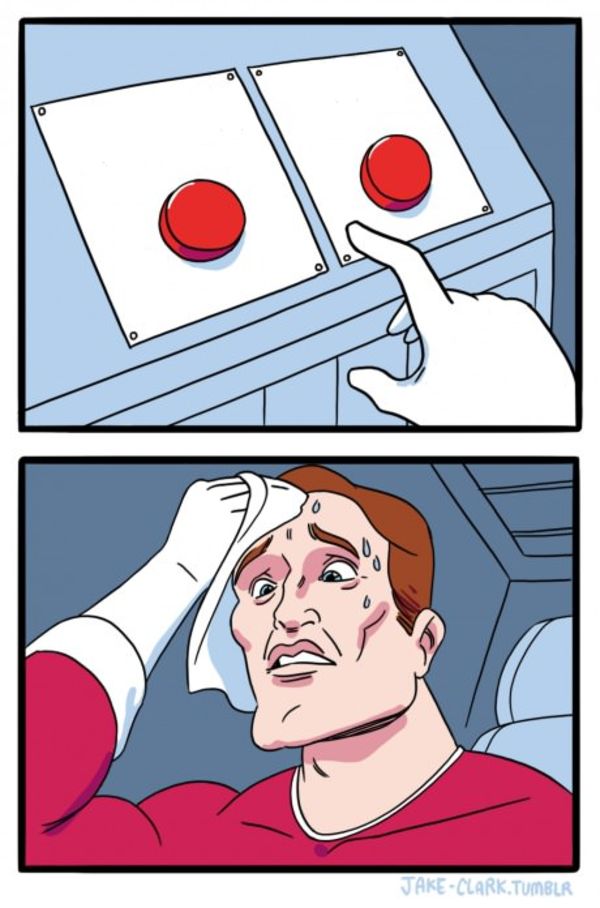
"Two Buttons," also known as "Daily Struggle," began with a comic that animator Jake Clark posted to his Tumblr on October 25, 2014 (Know Your Meme entry). It shows a visibly shaken figure wiping sweat from his brow, unable to press either of two buttons. Clark said the drawing was inspired by the "Sweating Towel Guy" illustration and by Hank Nova, a character from the game TimeSplitters 2.
The format survived because of the structure of its blanks. What the two buttons say changes the meaning entirely, and the drawing itself carries only one piece of information — a person agonizing — so it attaches to any subject. It also doubles as a weapon: put two options on the buttons that do not actually conflict, or where one is obviously correct, and the image mocks whoever is hesitating.
Spread
The original Tumblr post gathered over 9,700 notes within two years. On February 1, 2015 it was submitted to Imgur as "Daily Struggle," and it went on to score 3,738 points at 91% upvoted on Reddit's r/funny, cementing it in English-language meme vocabulary. Variations on political and social topics poured out through 2015; a "Tumblr's dilemma" version about gender discourse drew more than 4,400 upvotes on Reddit.
In November 2020, the artist Petirep introduced a version in which the character presses both buttons at once. That variant shifted the format away from contentious topics and toward everyday "I want both" dilemmas. Where the original mocked someone unable to choose, this one endorses refusing the choice. Know Your Meme catalogues 193 documented image variations, which gives a sense of how much the template has been reworked.
Usage
- Being unable to decide between two opposing options
- Mocking someone agonizing over two things that do not actually conflict
- Pointing at hesitation when the answer is obvious
- Refusing the binary altogether, via the press-both version