Is This a Pigeon?
TL;DR · Origin"Is This a Pigeon?" comes from a scene in season 1, episode 3 of the Japanese anime The Brave Fighter of Sun Fighbird, an entry in the Brave series that began airing in Japan…
Origin
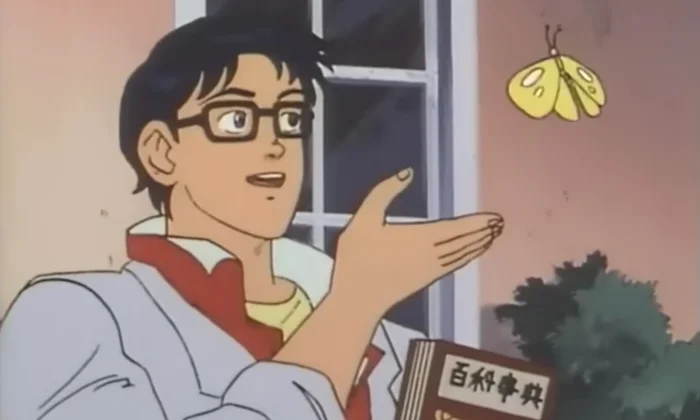
"Is This a Pigeon?" comes from a scene in season 1, episode 3 of the Japanese anime The Brave Fighter of Sun Fighbird, an entry in the Brave series that began airing in Japan in 1991.
The character in the scene is Yutaro Katori, an android built by Professor Hiroshi Amano. Studying terrestrial nature, he points at a butterfly that flutters past and asks, "Is this a pigeon?" The absurdity has an in-universe explanation: the consciousness inhabiting Yutaro's body is Fighbird, an energy-based lifeform from the Space Police Force, newly arrived on Earth and with no real grasp of what anything here is.
Worth noting: the line is often assumed to be a subtitle mistranslation. It isn't. The character genuinely mistakes the butterfly for a pigeon; the translator did not get it wrong.
Spread
The scene became a meme twenty years after it aired. On December 6th, 2011, a Tumblr user called "Indizi dell'avvenuta catastrofe" posted the screenshot, and it accumulated over 111,000 notes within three years, establishing itself as a reaction image for confusion.
The second wave came on Twitter in late April and early May 2018. This time it evolved past a simple reaction: users labeled the butterfly, the character and the subtitle separately, turning the image into a way of pointing out who is calling what by the wrong name. Netflix's official account posted a well-known example on May 3rd, using the format to needle the practice of casting twenty-eight-year-olds as high schoolers; it drew roughly 40,400 likes and 9,400 retweets in a week.
Variations
June 2018 brought a "female version": a character from You're Under Arrest holding actual pigeons, captioned "Is this a butterfly?" — the original inverted. That post passed 77,300 likes and 35,800 retweets within 72 hours, outperforming the format it derived from.
The template's reach comes from having three labelable slots: the person pointing, the thing pointed at, and the question itself. Depending on how the three are filled, it becomes self-deprecation or industry criticism.
How It's Used
- When someone is plainly mistaking one thing for a completely different thing
- Labeling and calling out a bad convention in an industry or community
- Confessing that you yourself had something badly wrong
- Mocking an argument that makes an absurd comparison in earnest
Sources
- Know Your Meme, "Is This a Pigeon?" — the Sun Fighbird season 1 episode 3 source, the December 6th, 2011 Tumblr post and its note count, and the 2018 Netflix post and female-version figures
- Wikipedia, "Is this a pigeon?" — Yutaro Katori's premise and confirmation that the line is not a mistranslation
- Forbes, "Nobody Really Seems To Understand Where The 'Is This A Pigeon?' Meme Actually Comes From" (May 16th, 2018) — how the source was widely misattributed