Beom-bu
TL;DR · Origin "Beombu" (凡夫) is originally a Buddhist term. It refers to an ordinary worldly person, bound by earthly desires and unenlightened — a Sino-Korean word that had been in the la…
Origin
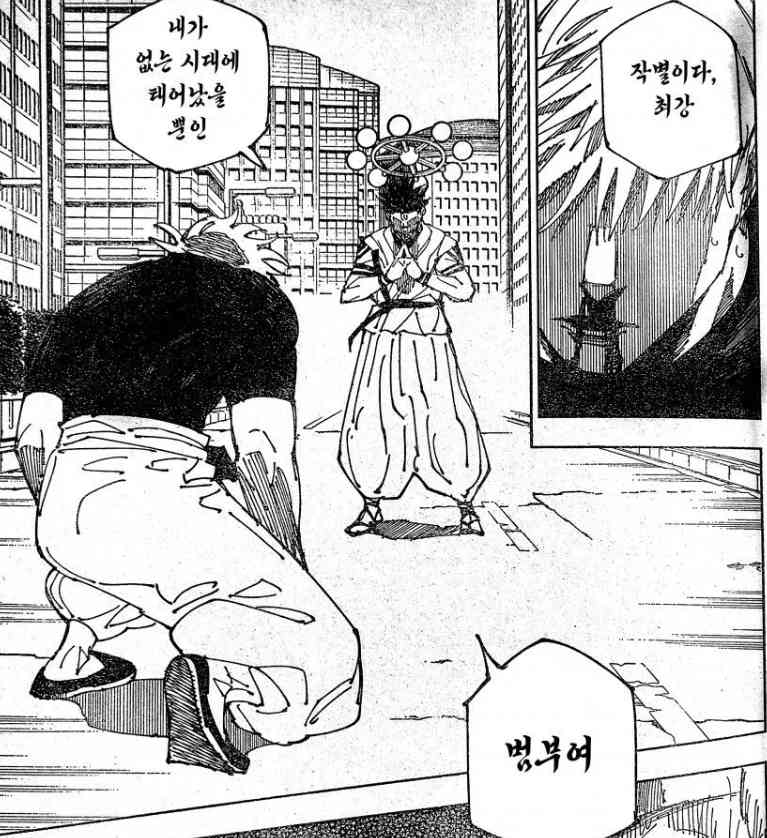
"Beombu" (凡夫) is originally a Buddhist term. It refers to an ordinary worldly person, bound by earthly desires and unenlightened — a Sino-Korean word that had been in the language for centuries. What revived this archaic term as 2020s internet slang was the Japanese manga Jujutsu Kaisen.
The decisive scene comes in chapter 236, released on 24 September 2023. In the Shinjuku Showdown arc, after his fight with Gojo Satoru ends, Ryomen Sukuna stands over the fallen Gojo and says: "Farewell, strongest. You were merely a common man born in an era without me." The line demotes the man the series called the strongest not by disputing his power, but by reducing it to a matter of when he happened to live.
How the line works
The reason it spread is the unusual shape of the insult. A normal victory line ends at "you were weak," but Sukuna never denies that Gojo was strong. He says instead that Gojo was strong only because Sukuna was absent from that era. It pretends to acknowledge the opponent's achievement while confiscating the conditions that made it possible — which lands harder than plain contempt.
The dated register of the word does the rest. Reaching for a stiff, near-obsolete Sino-Korean noun to declare someone "just an ordinary person" reads as an insult delivered in formal dress. Chapter 236 also happened to depict the defeat of an enormously popular character and set off heated argument among readers, which carried the line well outside the manga's own fandom.
Usage
- Teasing a former great — "merely a common man born in an era without X"
- Declaring a generational shift — the closing line when a newcomer displaces the incumbent
- In record-comparison arguments — dismissing statistics as having been built against weak competition
- Self-deprecation — "I'm just a beombu"
- Standing alone — a one-word verdict that someone is unremarkable
Variants and derivatives
The most common form is substitution: swap another name into the slot occupied by "strongest." Athletes, esports pros, idol groups, companies — anything that once stood at the top and has since been pushed aside. Because the template presupposes that the target really was strong, it shows up in fandom arguments more often than plain abuse does.
Conversely, "beombu" alone has settled in as a standalone noun. Stripped of its source context it simply means "an ordinary person, nobody special," and in that sense it is used by people who have never read Jujutsu Kaisen. A Buddhist term passed through a manga line and landed as general internet vocabulary.
Sources
- Namu Wiki, "Beombu" — the Buddhist sense of the word and how it was repurposed as a meme
- Namu Wiki, "Ryomen Sukuna (Jujutsu Kaisen) / In-story actions" — context of the "Farewell, strongest" scene
- Namu Wiki, "Shinjuku Showdown" — the arc containing the Gojo vs Sukuna fight
- ComingSoon, "Jujutsu Kaisen Chapter 236 Release Date, Time, & Where to Read" — chapter 236 released 24 September 2023
- Siliconera, "When Does Chapter 236 of the Jujutsu Kaisen Manga Release?" — confirmation of the release schedule