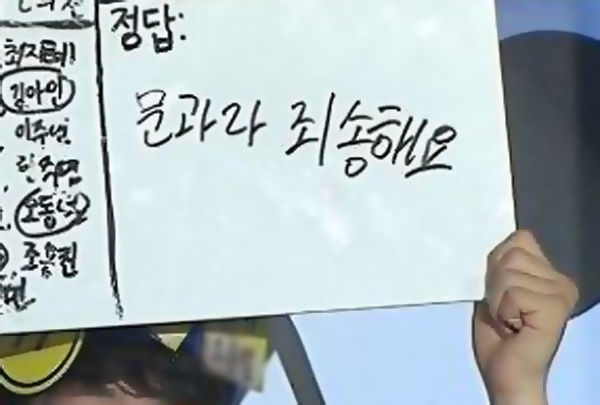
Munsonghamnida
TL;DR · Origin‘Munsong-hamnida’ contracts ‘munkwa-raseo joesong-hamnida’ — ‘sorry for being a humanities major’. It is thought to have emerged as …
Origin
‘Munsong-hamnida’ contracts ‘munkwa-raseo joesong-hamnida’ — ‘sorry for being a humanities major’. It is thought to have emerged as a neologism around 2015, arising not from any one person or post but from the atmosphere of the job market itself.
It is used in two situations. The lighter one is failing to get a science joke of the kind that assumes high-school physics or chemistry. The heavier one is the real point. Through the 2010s, as the Korean economy reorganised around engineering and IT, companies cut hiring for humanities positions sharply while expanding technical intake, and the employment rate between the two tracks diverged. Faced with that gap, humanities and social science graduates began lowering themselves with this phrase.
Spread
Its companion term from the same period is ‘in-gu-ron’, a contraction of ‘90 per cent of humanities graduates are idle’. If munsong-hamnida is the posture, in-gu-ron is the pseudo-statistic. The two were reported together, as in SBS News’s ‘In-gu-ron, Munsong-hamnida … the frustrated humanities job market’.
What is unusual about the phrase is its lifespan. Where most catchphrases vanish within a few years, this one is still in use more than a decade on — the local outlet MS TODAY ran a piece headlined ‘The neologism that will not go away after more than ten years’ — because the condition it names has not been resolved. As the difficulty persisted, further coinages appeared subdividing the humanities themselves into narrower and broader prospects.
Usage
- Light self-deprecation on missing a science joke or a technical term
- A pre-emptive lowering of oneself when stating one’s major
- A set phrase in any discussion of humanities employment, usually alongside in-gu-ron
It takes the form of a joke but was not made to be funny. It is less an actual apology than a way of pointing at a structure through the form of one — which is why, aimed by someone else at a humanities student, it becomes mockery.
Sources
- Namuwiki, ‘Munsong-hamnida’ — the estimated 2015 emergence; the two usage contexts; the 2010s industrial shift and hiring cuts; the derivative ‘in-gu-ron’
- SBS News, ‘In-gu-ron, Munsong-hamnida … the frustrated humanities job market’ — contemporary coverage treating the two coinages together
- MS TODAY, ‘The neologism “munsong-hamnida” that has not disappeared in over ten years’ — on its persistence and why
- Hongik University Press, ‘Where did “munsong-hamnida” begin?’ — a student-press feature on the phrase’s origins