Jeju Island Authentic Dialect
TL;DR · Origin In early September 2020, as Typhoon Maysak passed over the Korean peninsula, JTBC News ran a report from storm-damaged Jeju. Midway through the piece came an interview with …
Origin
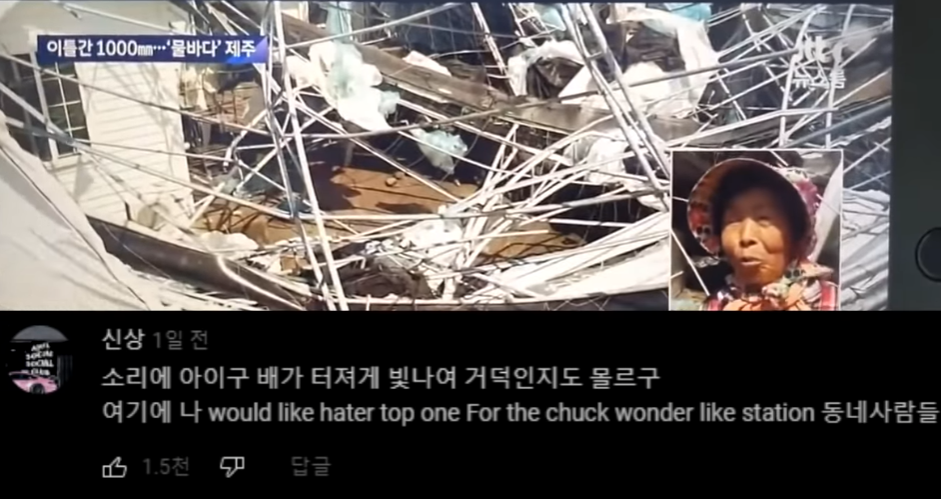
In early September 2020, as Typhoon Maysak passed over the Korean peninsula, JTBC News ran a report from storm-damaged Jeju. Midway through the piece came an interview with an elderly Jeju resident whose home had been hit, delivered in unmixed Jeju dialect — effectively unintelligible to mainland viewers.
The trend began when someone clipped just that segment and uploaded it to YouTube under the title "Jeju dialect you cannot understand," and the algorithm picked it up. It was then reposted across community boards under headings like "real Jeju dialect." The broadcast had subtitles, yet the fact that you could not follow along without them only amplified the interest.
Spread
What kept this from staying a simple "incomprehensible dialect" clip was the comment section. Viewers transcribed what they thought they heard, and the results happened to read like rap lyrics. The rapid breathing and clipped intonation characteristic of Jeju speech struck listeners as resembling a rap flow, and the comments became content in their own right.
The next step was decisive. Someone laid a hip-hop beat under the interview audio and uploaded it as "A Jeju dialect grandmother's killing verse, live," and when that video also caught the algorithm the interviewee was recast as a "hip Jeju grandmother." A disaster-report interview had been flipped into music content.
Derivatives followed from there: versions with different beats, versions with lyric subtitles, and attempts at the same format using other regional dialects.
Usage
- On hearing something unintelligible — the joke that subtitles are required
- Encountering heavy dialect — expressing the barrier between regional varieties
- When speech is fast and rhythmic — calling it a "killing verse"
- Across Jeju dialect content generally — as a stock tag
The other side of it
The meme was consumed as comedy, but the situation of Jeju language sits behind it. Jeju is classified by UNESCO as an endangered language, and local press has run continuing features on how to preserve it. That mainland viewers were startled to find they could not understand something that is nominally Korean is itself an inadvertent demonstration that Jeju functions less as one dialect of Korean than as a system of its own.
Sources
- Namu Wiki, "Real Jeju dialect" — the JTBC interview during Typhoon Maysak as the source, the title of the YouTube clip and how it spread, the rap-lyric transcriptions in comments
- YouTube, "A Jeju dialect grandmother's killing verse, live" — the derivative video with a hip-hop beat
- FMKorea, "Real Jeju dialect" — community spread post
- Dogdrip, "Real Jeju dialect" — community circulation post
- Media Jeju, "Jeju language faces extinction: is there any way to save it?" — the endangered status of Jeju language
- Wikipedia (Korean), "Typhoon Maysak (2020)" — timing of its impact on Korea in early September 2020