Youth Who 'Just Rested'
TL;DR · 'Youth Who Just Rested' (쉬었음 청년) combines the activity-status category 'rested' (쉬었음), used by Statistics Korea's Economically Active Population Survey to classify the economically…
'Youth Who Just Rested' (쉬었음 청년) combines the activity-status category 'rested' (쉬었음), used by Statistics Korea's Economically Active Population Survey to classify the economically inactive population in detail, with the survey's target age bracket of 15 to 34, i.e., youth. This category applies to respondents who did not work in the week before the survey, were not job-hunting, and had no clearly classifiable reason such as childcare, housework, formal education, or illness, but simply answered that they were 'just resting.' Originally just one neutral option among many on a statistical questionnaire, the term took on a strong social connotation of 'youth who neither work nor seek work' once it was applied specifically to young people, and it began to circulate almost like a coined slang term.
The statistical term itself is reported to have existed since a January 2003 revision of the survey's categories, and for a long time it remained an administrative term used mainly by experts and policymakers. The moment it entered wider public awareness is understood to be between 2024 and 2025, when youth employment problems resurfaced as a major social issue. A series of Statistics Korea announcements that the number of 'resting' youth had hit record highs made headlines repeatedly, imprinting what had been a dry statistical classification onto the public consciousness. From there, the phrase moved into online communities and social media as slang referring to youth unemployment and job-search abandonment.
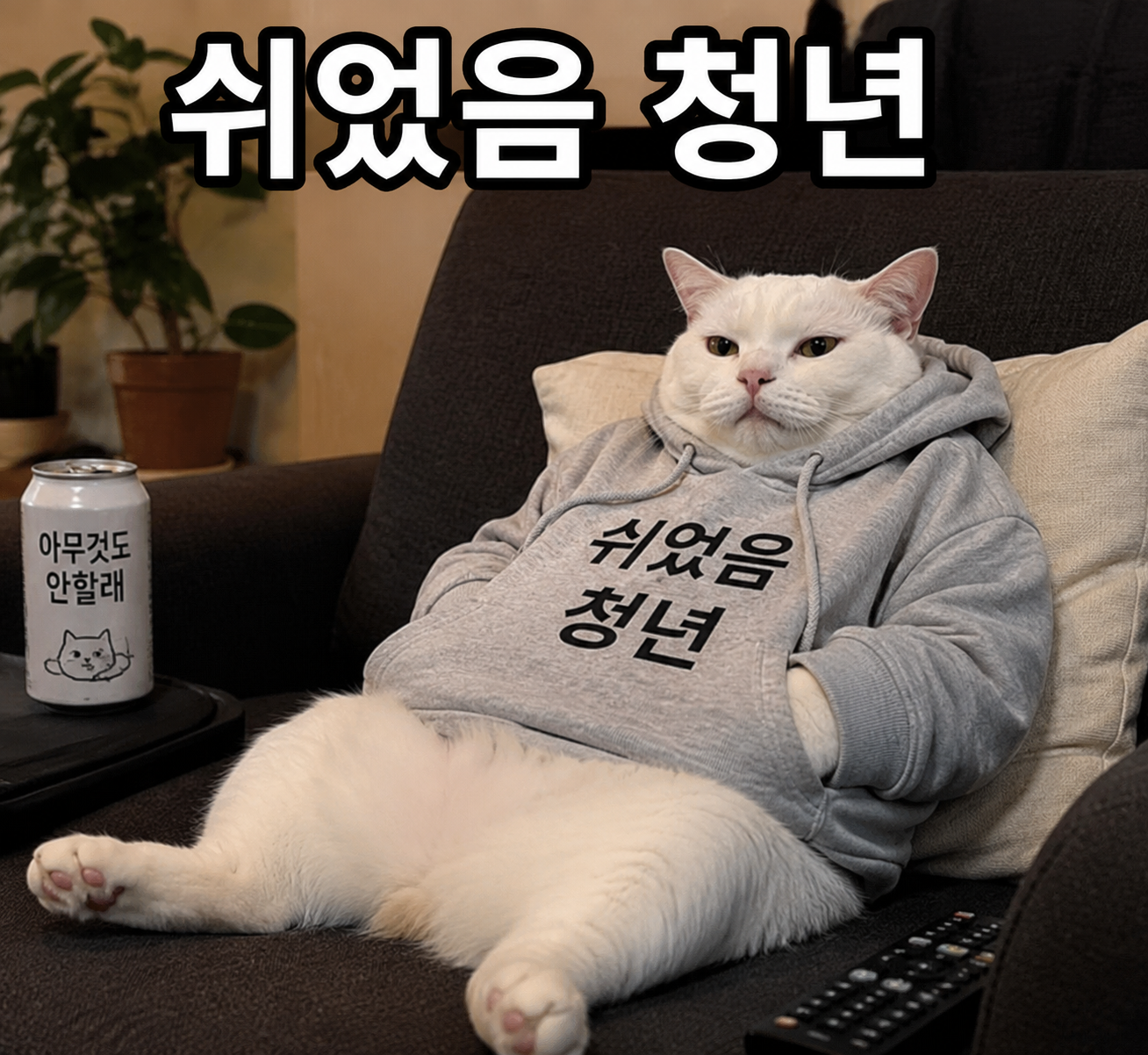
As it spread, 'Youth Who Just Rested' came to replace, or sit alongside, existing terms such as 'baeksu' (jobless person) and 'NEET.' Notably, the way it is consumed as a meme centers on self-deprecating humor. Online examples repeatedly show people jokingly declaring 'as of today, I too am a resting youth' after a day spent with nothing to show for it, or sarcastically saying that putting in effort with no real result is 'no different from just resting.' News that the Ministry of Employment and Labor, concerned about the term's stigmatizing effect, solicited and proposed alternative wording became a newsworthy topic in its own right, further fueling the meme's spread.
Linguistically, 'Youth Who Just Rested' stands out for being adopted directly as a popular slang term from an existing administrative and statistical phrase, rather than through typical coinage. It resonates emotionally with earlier neologisms expressing the frustration and self-mockery of 2010s Korean youth, such as 'Hell Joseon,' 'Dirt Spoon,' and 'This Life Is Ruined,' but differs in method: those terms compressed emotion into newly invented words, whereas this one simply repurposes an official government statistical phrase. It illustrates how public, administrative language can be appropriated into a self-mocking meme, showing how quickly the distance between statistics and everyday speech can narrow once mediated by social media.
The phrase has spread from news articles and current-affairs broadcasts into social media content on YouTube, X, and Instagram, and it has become a recurring keyword in discourse on youth employment policy. It is seen both as reflecting young people's tendency to process the heavy social problem of unemployment through light, self-deprecating humor, and as raising concern over the stigmatizing effect of the statistical label itself. Each year since 2024, whenever new youth employment statistics are released, related memes and reactions have reappeared, and 'Youth Who Just Rested' continues to be cited as one of the representative expressions of how this generation experiences the labor market.