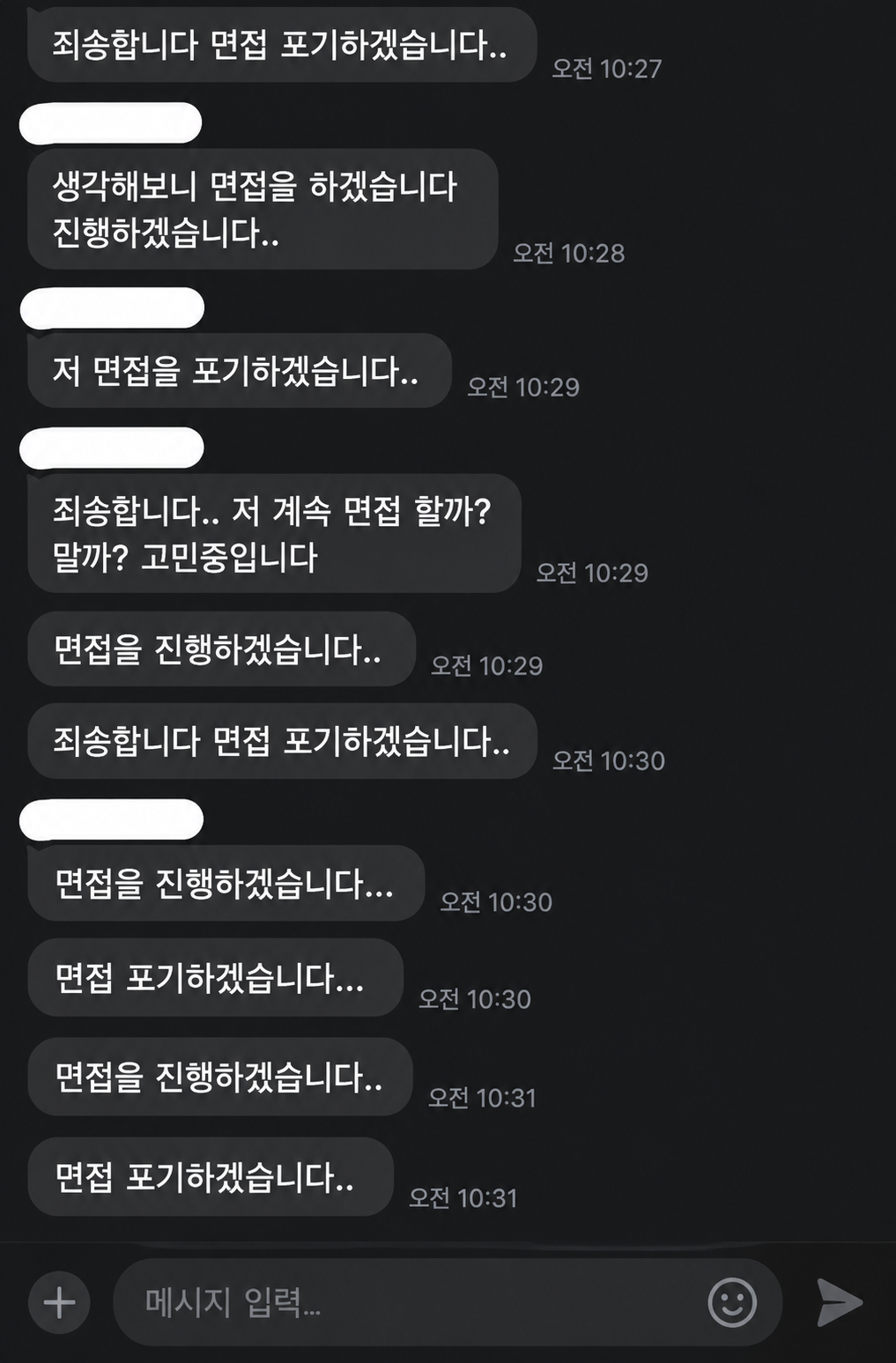
I'd Like to Cancel the Interview
TL;DR · OriginI'd like to cancel the interview is a Korean text meme that began with a screenshot of messages sent by a job applicant to a company on the morning of an interview. In the ca…
Origin
I'd like to cancel the interview is a Korean text meme that began with a screenshot of messages sent by a job applicant to a company on the morning of an interview. In the capture, the lines 'I'd like to cancel the interview' and 'Actually, I will come to the interview' alternate at intervals of roughly one minute, starting around 10:27 in the morning, so that several complete reversals of mind sit preserved in a single image with timestamps attached. The humour does not come from the applicant being rude; it comes from the fact that ordinary pre-decision panic, the kind most people experience privately, was recorded minute by minute and left legible. The August 2026 meme roundup published by the marketing outlet Gogumafarm listed the screenshot among the month's representative memes.
How it is used
The method is simple. Users replace the word 'interview' with whatever they are facing and then write out a cancellation and a reversal separated by a short interval. Because a single substitution completes the joke, the barrier to entry is almost nothing, and keeping the timestamps of a messaging app visible preserves the flavour of the original.
- Reversing a resolution, as in announcing that a diet is abandoned and then restarting it a minute later
- Deferring a large decision, as in resigning and then agreeing to stay a little longer
- Standing in for the state of mind just before an exam, a presentation or an appointment
- Brand accounts borrowing the shape to tease a product launch they pretend to be postponing
Spread and variants
The screenshot travelled through August 2026 across meme aggregation accounts on X and community boards, and its spread was attributed partly to timing: August in Korea concentrates job applications, examinations and holiday plans, all of which produce exactly the kind of wavering the capture documents. Brand accounts adopted the format to imitate the hesitation of a shopper deciding whether to buy, which extended its reach into advertising. By September the object of the wavering had shifted from an interview to the calendar itself, and a variant reading roughly 'I'm giving up on September... no, I will live September properly' circulated widely. That version replaced the original timestamps with dates, applying the same sentence shape to ambivalence about the remaining months of the year. A large part of the format's reach comes from the fact that it does not need the original image at all. Text alone carries it, so it moved without friction between community post titles, group chats and the subtitles of short videos. A convention also emerged of shortening the stated interval between each reversal as the post goes on, so that the indecision visibly accelerates toward the end, which turns a flat joke into something closer to a small escalating scene.