Pohanghang
TL;DR · Origin "Pohang-hang" is both the name of the harbor in Pohang, North Gyeongsang Province, and a pun on the fact that the name sounds like laughter. Add one more "hang" to "Pohang" …
Origin
"Pohang-hang" is both the name of the harbor in Pohang, North Gyeongsang Province, and a pun on the fact that the name sounds like laughter. Add one more "hang" to "Pohang" and you get "Pohang-hang"; stretch it further into "Pohang-hang-hang" or "Pohah-hah-hang" and it reads as someone snickering at you. A place name doubling as onomatopoeia is an unusual setup.
The wordplay hardened into a meme after a specific match: K League 1 round 17, Gangwon FC vs Pohang Steelers, 23 June 2019. Pohang led 4-0 after scoring twice in the first half and twice more by the 56th minute, but Gangwon brought on veteran Jung Jo-gook, went all-out on attack, and put five goals away in the final 25 minutes — three of them inside five minutes of stoppage time. With a Cho Jae-wan hat-trick and Jung Jo-gook's winner, the match finished Gangwon 5-4 Pohang. It was the first four-goal comeback in K League history.
Spread
Immediately after the match, the football community FMKorea filled up with "Pohang-hang" replies mocking Pohang supporters. The collapse was dramatic enough, and the club's own name converted so cleanly into a laugh, that three syllables did the whole job — no image macro or catchphrase required.
Usage quickly spilled outside football. "Pohang-hang" got attached to any post where someone had failed or been humiliated, and it became a fixture under posts about breakups in particular. Being simultaneously a laugh and a real place name, it slots into almost any context without looking forced.
Notably, the side being mocked absorbed the meme. Pohang fans began firing "Pohang-hang" at opposing supporters after wins, and the Pohang Steelers' official social accounts took up the phrase as well. A meme that started as an insult was flipped into a club marketing asset.
Usage
- Lightly mocking someone's failure — reply with nothing but "Pohang-hang"
- Stretching the laugh — "Pohang-hang-hang", "Pohah-hah-hang"
- Under posts about breakups, rejections, failed exams — the stock reply instead of sympathy
- After a Pohang Steelers win — fired back by Pohang fans at the opposition
Variants and derivatives
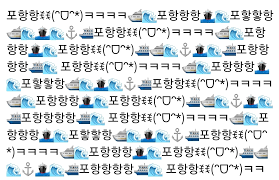
In text it is conventionally written with a smiling kaomoji as 포항항ꉂꉂ(ᵔᗜᵔ*), and it is also common to add ship, wave and anchor emoji, playing on the literal harbor meaning.
The most widespread derivative is the question-and-answer format "How do people from Pohang laugh?" — ask, then answer "Pohang-hang." It began as community posts and moved into short-form video on TikTok and Instagram, reaching users with no interest in football at all. At that stage the original mockery has largely evaporated and it circulates as pure wordplay. Attempts to swap in other Korean place names exist, but few have a syllable that maps onto laughter the way "hang" does, so none has stuck like Pohang.
Sources
- Namu Wiki, "Pohang-hang" — spread after the 23 June 2019 match, FMKorea usage, official club social media use
- Namu Wiki, "K League 1 / 2019 / Round 17 Gangwon vs Pohang" — the 5-4 scoreline, five goals in the last 25 minutes, Cho Jae-wan's hat-trick, Jung Jo-gook's winner
- FMKorea, "Do you know how people from Pohang laugh?" — community post of the Q&A derivative
- Instiz, "Do you know what people from Pohang sound like when they laugh?" — spread beyond football communities
- Dogdrip, "Memes with genuinely unexpected origins" — community post explaining the origin