나의 죽음이 너의 삶보다 더 가취 있기를
TL;DR · OriginThe line comes from the Korean subtitles of the 2019 film Joker. Arthur Fleck writes it in his notebook; the original English reads "I just hope my death makes more 'cents' t…
Origin
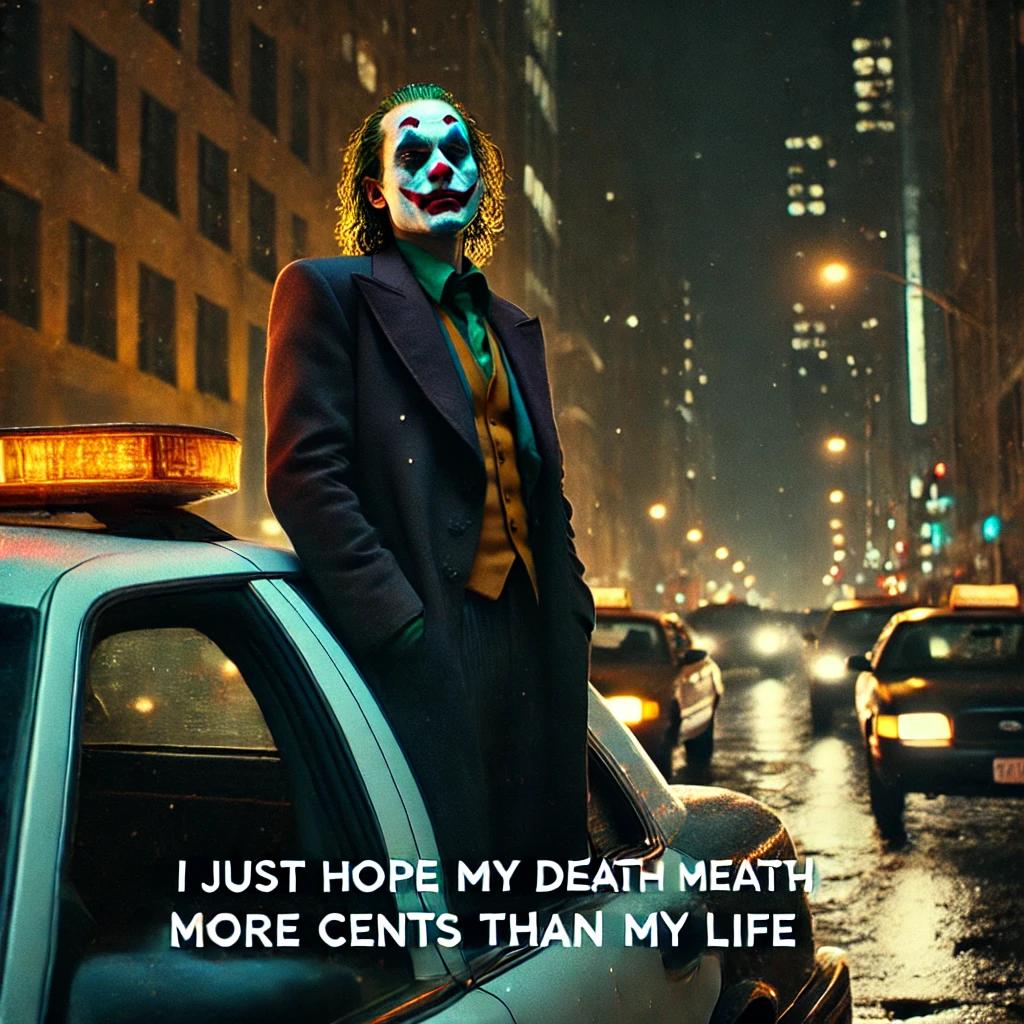
The line comes from the Korean subtitles of the 2019 film Joker. Arthur Fleck writes it in his notebook; the original English reads "I just hope my death makes more 'cents' than my life," and the Korean subtitle rendered it as "I hope my death has more 'gachwi' than my life…"
The English line turns on a pun. "Cents" and "sense" are homophones, so the sentence reads simultaneously as hoping one's death is worth more money than one's life and as hoping it makes more sense. The screenplay itself carried a footnote noting that "cents" was a homophone of "sense."
The subtitle transferred that doubleness onto the gap between 가치 (gachi, "value") and 가취 (gachwi). The latter looks like a misspelling, but it is also a real Korean word meaning the extra thrown in with a purchase — so the choice caught the near-identical pronunciation, the playfulness of an apparently deliberate misspelling, and an actual dictionary meaning all at once.
Spread
On release the subtitle became a mistranslation controversy, since many viewers simply read it as a typo. In an October 10th, 2019 report by Newsen, a representative for the distributor said it was "not a simple spelling error," explaining that 가취 was chosen because it sounds close to 가치, works as wordplay resembling a deliberate misspelling, and carries a meaning of its own. They added that it was not one translator's call but the outcome of internal discussion.
The argument continued after that statement, but in the course of it the sentence settled into community usage. Korean boards such as FM Korea, Ruliweb and Theqoo filled with posts asking what the line meant alongside posts proposing better translations, and the construction "may X have gachwi" became a stock quotation for a while.
Variations
The version that circulates online differs slightly from the subtitle. The film says "my death… than my life"; the meme often swaps the second half to "than your life," turning it outward at someone else. That version is a taunt rather than self-deprecation, so it reads quite differently from the original.
Detaching just the misspelled word also became standard. Writing something earnest and slipping 가취 into it — "may this too have gachwi" — signals the source while pretending to misspell.
How it is used
- As a joke, deliberately writing 가취 when wishing that someone's effort not go to waste
- As the standard example when discussing translation controversies or liberal renderings
- As a film quotation used self-deprecatingly
- As an allusion, using the apparent misspelling alone to point at the source
Sources
- Newsen, "Answering the Joker translation controversy: 'may this too have gachwi'" (October 10th, 2019) — the original line, the subtitle, the distributor's explanation, and that the choice came out of internal discussion
- Namuwiki, "Joker (2019)" — the screenplay's homophone footnote, the dictionary meaning of 가취, and how the line became a meme
- Theqoo, "What does 'gachwi' in Joker even mean?" — a post showing how audiences received the subtitle at the time