Holy Moly
TL;DR · Origin "홀리몰리" is the Korean transliteration of the English exclamation "holy moly." The original goes back at least to 1890: an instance appears in the newspaper The Referee on 15 …
Origin
"홀리몰리" is the Korean transliteration of the English exclamation "holy moly." The original goes back at least to 1890: an instance appears in the newspaper The Referee on 15 October 1890, and it turns up again in Nat Gould's 1892 novel Running it Off; or, Hard Hit.
Formally it is a minced oath — a sound-alike swerve around "Holy Moses" or "Holy Mary" that avoids invoking a holy name directly. "Moly" therefore means nothing on its own; the occasional claim that it refers to the herb moly from Greek mythology is unsupported. The phrase spread widely in the United States through Fawcett Comics' Captain Marvel (now Shazam), whose alter ego Billy Batson used it as a catchphrase.
Use in Korean
In Korean it is the sound, not the meaning, that carries it: the repeating vowels and the doubled "l" give it a bounce that works as an interjection even for speakers who do not know the phrase. Hence the fondness for extending the rhyme rather than using it alone.
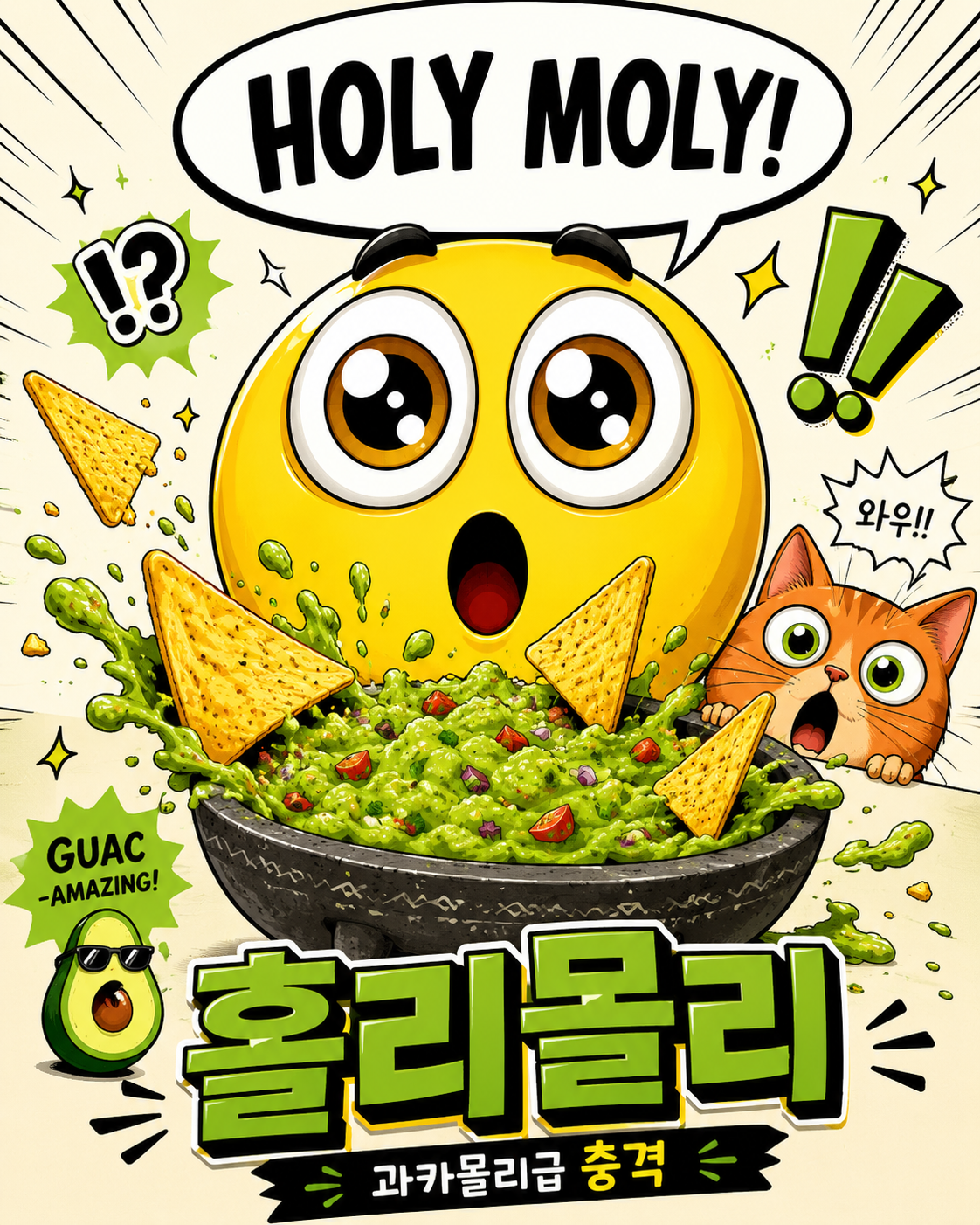
- Rhyming extensions — "holly-moly guacamole" and similar chains
- A trailing "홀리몰리…" to signal weary disbelief
- Written variants: consonants only (ㅎㄹㅁㄹ), or all caps "HOLY MOLY!" to raise the volume
Taken in by pronunciation rather than translation, it is a clean example of a borrowed interjection kept for how it sounds.